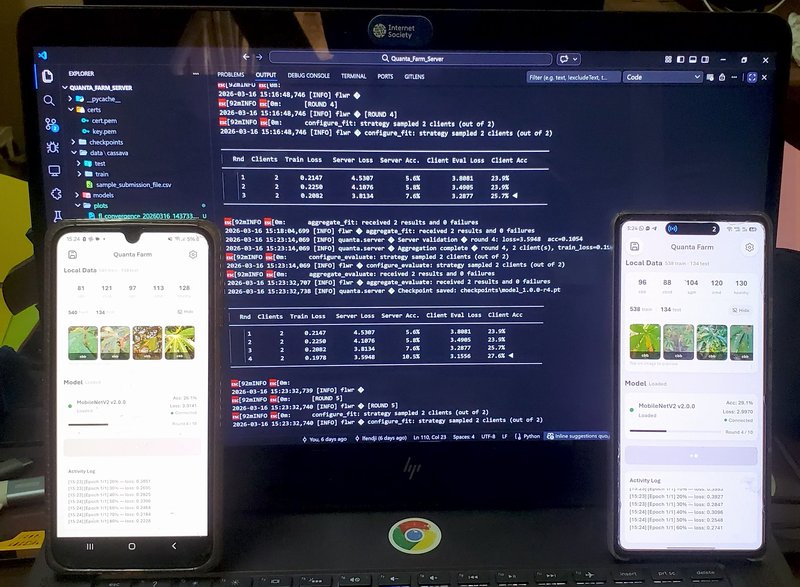
Smallholder cassava farmers in sub-Saharan Africa face devastating crop losses from leaf diseases such as Cassava Mosaic Disease (CMD), Cassava Brown Streak Disease (CBSD), Cassava Bacterial Blight (CBB), and Cassava Green Mite (CGM), yet access to expert plant pathologists in rural areas remains critically limited. We present FedFarm, a Federated Learning (FL) system that empowers farmers to collaboratively train a cassava disease classifier directly on commodity Android smartphones, without ever transmitting raw images to a central server. This ensures the privacy of vulnerable agricultural communities while overcoming the bandwidth constraints typical of rural connectivity. FedFarm employs a split-model design in which a pretrained frozen MobileNetV2 backbone handles on-device feature extraction, while only a lightweight classification head (~25 KB) is exchanged per communication round using the Federated Averaging algorithm, making the system viable even on 3G networks. In a real-world proof-of-concept deployment on two heterogeneous commodity devices, server-side classification accuracy improved from 28.2% to 66.9% across 100 rounds, well above the 27.7% majority-class baseline, while raw farmer data never left the device. FedFarm demonstrates that privacy-preserving, communication-efficient AI is achievable on the hardware that smallholder farmers already own, offering a replicable blueprint for responsible AI deployment in food-insecure, low-resource agricultural settings across the Global South.
Overview
FedFarm is a mobile-oriented Federated Learning (FL) system designed to classify cassava leaf diseases directly on Android devices. It represents a comprehensive FL solution tailored to this specific agricultural challenge. The system operates on standard Android smartphones,
References
[1] Meenakshi Aggarwal, Vikas Khullar, Nitin Goyal, Rama Gautam, Fahad Alblehai,
Magdy Elghatwary, and Aman Singh. 2023. Federated Transfer Learning for
Rice-Leaf Disease Classification across Multiclient Cross-Silo Datasets. Agronomy
13, 10 (2023), 2483. doi:10.3390/agronomy13102483
[2] Prabhnoor Bachhal, Vatsala Anand, Shubham Gargrish, Umesh Kumar Lilhore,
Sarita Simaiya, Haitham Y Adarbah, Afzel Noore, and Hanaa A Abdallah. 2026.
Optimizing federated learning for maize leaf disease classification using internet
of agricultural things. Cluster Computing 29, 2 (2026), 100.
[3] Daniel J Beutel, Taner Topal, Akhil Mathur, Xinchi Qiu, Javier Fernandez-Marques,
Yan Gao, Lorenzo Sani, Kwing Hei Li, Titouan Parcollet, Pedro Porto Buarque de
GusmÃG, o, et al. 2020. Flower: A friendly federated learning research framework.
arXiv preprint arXiv:2007.14390 (2020).
[4] Léon Bottou. 2012. Stochastic gradient descent tricks. In Neural networks: tricks
of the trade: second edition. Springer, 421–436.
[5] Rahool Dembani, Ioannis Karvelas, Nur Arifin Akbar, Stamatia Rizou, Domenico
Tegolo, and Spyros Fountas. 2025. Agricultural Data Privacy and Federated
Learning: A Review of Challenges and Opportunities. Computers and Electronics
in Agriculture 232 (2025), 110048. doi:10.1016/j.compag.2025.110048
[6] Jia Deng, Wei Dong, Richard Socher, Li-Jia Li, Kai Li, and Li Fei-Fei. 2009. Imagenet:
A large-scale hierarchical image database. In 2009 IEEE conference on computer vision and pattern recognition. Ieee, 248–255.
[7] Food and Agriculture Organization of the United Nations. 2005. A Review of
Cassava in Africa. Technical Report. FAO and International Fund for Agricultural
Development, Rome, Italy. Proceedings of the Validation Forum on the Global
Cassava Development Strategy.
[8] Arnauld Nzegha Fountsop, Jean Louis Ebongue Kedieng Fendji, and Marcellin
Atemkeng. 2020. Deep Learning Models Compression for Agricultural Plants.
Applied Sciences 10, 19 (2020), 6866. doi:10.3390/app10196866
[9] Andrew G Howard, Menglong Zhu, Bo Chen, Dmitry Kalenichenko, Weijun
Wang, Tobias Weyand, Marco Andreetto, and Hartwig Adam. 2017. Mobilenets:
Efficient convolutional neural networks for mobile vision applications. arXiv
preprint arXiv:1704.04861 (2017).
[10] Peter Kairouz and H Brendan McMahan. 2021. Advances and open problems in
federated learning. Foundations and trends in machine learning 14, 1-2 (2021),
1–210.
[11] Raouf Kerkouche, Gergely Ács, Claude Castelluccia, and Pierre Genevès. 2021.
Constrained Differentially Private Federated Learning for Low-Bandwidth De-
vices. In Proceedings of the Thirty-Seventh Conference on Uncertainty in Artificial
Intelligence (Proceedings of Machine Learning Research, Vol. 161). PMLR, 1756–1765.
https://proceedings.mlr.press/v161/kerkouche21a.html
[12] Ameer Tamoor Khan, Signe Marie Jensen, Abdul Rehman Khan, and Shuai Li.
2023. Plant Disease Detection Model for Edge Computing Devices. Frontiers in
Plant Science 14 (2023), 1308528. doi:10.3389/fpls.2023.1308528
[13] Jakub Konečn`y, H Brendan McMahan, Felix X Yu, Peter Richtárik,
Ananda Theertha Suresh, and Dave Bacon. 2016. Federated learning: Strategies
for improving communication efficiency. arXiv preprint arXiv:1610.05492 (2016).
[14] Viraj Kulkarni, Milind Kulkarni, and Aniruddha Pant. 2020. Survey of person-
alization techniques for federated learning. In 2020 fourth world conference on
smart trends in systems, security and sustainability (WorldS4). IEEE, 794–797.
[15] Brendan McMahan, Eider Moore, Daniel Ramage, Seth Hampson, and
Blaise Aguera y Arcas. 2017. Communication-efficient learning of deep networks
from decentralized data. In Artificial intelligence and statistics. Pmlr, 1273–1282.
[16] Ernest Mwebaze, Timnit Gebru, Andrea Frome, Solomon Nsumba, and Jeremy
Tusubira. 2019. iCassava 2019 fine-grained visual categorization challenge. arXiv
preprint arXiv:1908.02900 (2019).
[17] Amanda Ramcharan, Kelsee Baranowski, Peter McCloskey, Babuali Ahmed, James
Legg, and David P. Hughes. 2017. Deep Learning for Image-Based Cassava Disease
Detection. Frontiers in Plant Science 8 (2017), 1852. doi:10.3389/fpls.2017.01852
[18] Amanda Ramcharan, Peter McCloskey, Kelsee Baranowski, Neema Mbilinyi,
Latifa Mrisho, Mathias Ndalahwa, James Legg, and David P. Hughes. 2019. A
Mobile-Based Deep Learning Model for Cassava Disease Diagnosis. Frontiers in
Plant Science 10 (2019), 272. doi:10.3389/fpls.2019.00272
[19] Mark Sandler, Andrew Howard, Menglong Zhu, Andrey Zhmoginov, and Liang-
Chieh Chen. 2018. Mobilenetv2: Inverted residuals and linear bottlenecks. In
Proceedings of the IEEE conference on computer vision and pattern recognition.
4510–4520.
[20] Xingwei Wang, Hong Zhao, and Jiakeng Zhu. 1993. GRPC: A communication
cooperation mechanism in distributed systems. ACM SIGOPS Operating Systems
Review 27, 3 (1993), 75–86.
Cite this page
Joachim Nedaouka;Jean Louis K. E. Fendji;Blaise Omer Yenke;Nikos Makris;Damien Saucez;Joyce Mwangam;Bamba Gueye;Marta Barroso;Raffaele Bruno;Michela Natilli;Marcellin Atemkeng;Serge Fdida. FedFarm: Privacy-Preserving Federated Learning for Cassava Disease Diagnosis on Smallholder Farmers' Smartphones. SUNIS, 2026. https://sunis.net/posts/fedfarm/
Published on SUNIS by Nedaouka Joachim.