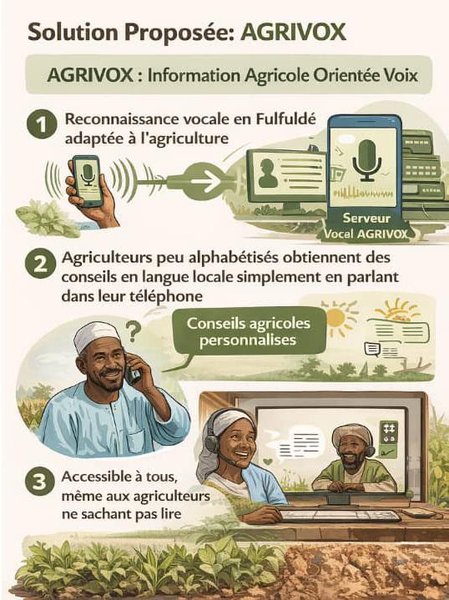
The AGRIVOX project is part of a technological and social innovation approach aimed at improving access to agricultural information for smallholders in northern Cameroon. In this region, agriculture is the primary pillar of livelihood and economic development. However, a large proportion of farmers face major difficulties in accessing reliable, up-to-date, and actionable information to optimize their farming practices.
-
Context and Problem Statement Despite the existence of digital agricultural decision-support platforms, these remain largely underutilized by rural populations. This situation is mainly explained by:
-
Low literacy rates.
- Language barriers: Interfaces are generally text-based and rarely adapted to local languages such as Fulfulde.
This digital divide significantly limits farmers' ability to benefit from technological innovations, keeping them tied to traditional practices that are sometimes less productive.
- The AGRIVOX Solution To meet these challenges, AGRIVOX proposes an innovative solution based on the integration of an intelligent voice interface. This allows farmers to interact with an agricultural information system simply by using their voice.
The project relies on advances in Artificial Intelligence, particularly Automatic Speech Recognition (ASR) and Natural Language Processing (NLP), to design a system capable of understanding and processing queries expressed in Fulfulde within an agricultural context.
Concretely, AGRIVOX aims to enrich an existing decision-support platform by integrating a voice layer accessible via mobile phones or other digital devices. Users will be able to ask questions in their local language (e.g., about suitable crops, weather, or farming practices) and receive tailored answers, thus facilitating decision-making.
- Project Objectives General Objective To democratize access to agricultural information through a local-language voice interface, in order to improve productivity, income, and living conditions for farmers, while promoting digital inclusion.
Specific Objectives To achieve this general objective, the project focuses on the following points:
- Develop an Automatic Speech Recognition model adapted to Fulfulde and local agricultural terminology.
- Build an agricultural voice data corpus in Fulfulde (collection, transcription, and annotation).
- Integrate an intelligent voice interface into an existing agricultural decision-support system.
- Design a simple, intuitive user interface accessible to farmers with low or no literacy.
- Test and evaluate system usability with end-users to optimize performance.
-
Promote the adoption of digital technologies in the rural agricultural sector.
-
Methodological Approach The project adopts an interdisciplinary, user-centered approach combining Artificial Intelligence, linguistics, and Human-Computer Interaction. It will be deployed in four main phases:
-
Data Collection and Preparation: Recording voice data from farmers, followed by transcription and annotation.
- Speech Recognition Model Development: Training and optimizing deep learning models adapted to Fulfulde.
- Technological Integration: Implementing the voice interface connected to the agricultural information system.
- User Testing and Improvement: Real-world evaluation and system adjustments.
Ethical Note: Particular attention will be paid to participant consent, data protection, and the consideration of linguistic diversity.
-
Expected Results The deployment of the AGRIVOX project should lead to the following deliverables and outcomes:
-
A high-performance speech recognition model in Fulfulde with high accuracy for agricultural queries.
- A rich and annotated voice data corpus, valuable for further research on under-represented African languages.
- A decision-support system controllable via voice commands and adapted to low-literacy users.
- Improved access to information, enabling more informed decision-making.
- An increase in agricultural productivity and income through the application of targeted advice.
-
A reduction of the digital divide in rural areas and increased adoption of AI in local agriculture.
-
Impact and Relevance
- Socio-Economic Impact: By facilitating access to information, the project contributes to food security, poverty reduction, and sustainable development. It promotes the social inclusion of marginalized populations (notably non-literate individuals and rural women).
- Scientific and Technological Impact: It helps bridge the resource gap for African languages in AI, paving the way for other voice applications (health, education, public services).
- Scalability: Designed as a replicable solution, AGRIVOX technology can be adapted to other regions, languages, and fields, making it a major asset for donors and development partners.